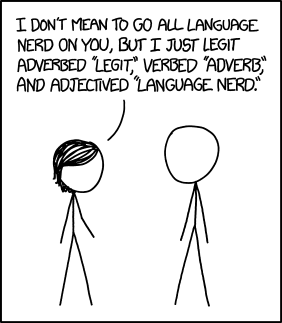
I won’t go off on a Ferris Bueller-esque rant about -isms in society today. I also won’t rant about people unnecessarily adding -esque to proper nouns. Having removed myself almost entirely from the realm of mainstream political news, I tend to encounter words like this less often than before.
Context
Season 3 – Episode 6 “The Limited” The ISIS gang is transporting Nova Scotian separatist, Kenny Bilko, back to Canada to curry favor with the RCMP. The unusual setting of a train and the general incompetence of the ISIS staff drives much of the plot. The action culminates on the roof of the train where Archer and Bilko discuss how fighting on the roof of a train is a ridiculous plot device.
I carry cash. I always have. As a member of the last generation to grow up before the widespread existence of cell phones, I learned to always have at least a little cash on hand, if not only in case of an emergency.
Overall, people carry very little cash. A May 2014 survey by Bankrate showed that more than two-thirds of adults carry less than $50 in cash at any given time. Nine percent of respondents reported carrying no cash at all.
Of course, there are benefits to using alternatives to cash. When cash is stolen, it’s gone. Using cash may be more time consuming in certain situations. Cash doesn’t earn cool perks like airline miles or a meager percentage rebate.
People are still using it, otherwise we wouldn’t keep printing it in newer, more colorful designs. In 2012, more than $358 billion (face value) of currency was printed, roughly 90% of which replaced damaged, out-of-circulation money.
So what are the benefits of using cash? Data from Intuit shows that 55% of small businesses do not accept credit card, though that number will continue to fall as it becomes even easier to accept cards through mobile point-of-sale systems like Square. Currently though, 45% of small business, some of which you may want to patronize, may not accept a card. Businesses (and those working in tipped professions) may prefer cash as it is easier to keep off the proverbial books. Keep in mind: during a power, phone, or internet outage, a business may be unable to process card transactions.
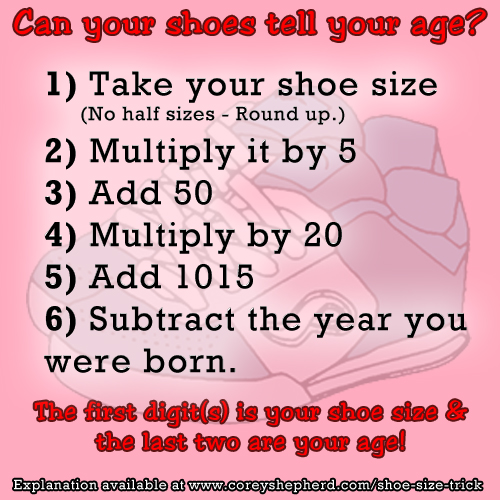
You’ve likely seen this type of math riddle before. Take some number, do some arithmetic, and you get some other number. This variation begins with your shoe size and ends with your age. Can your shoe size really determine your age? Of course not. The explanation is below the fold.
Editor’s note/spoiler alert: This riddle is current as of 2015. The number in step 5 must change for each year. The number provided is 1000 less than the current year. See below for more information.
If you recently upgraded to OS X Yosemite from Mavericks or another previous version, you may have found that your notes not synced to iCloud did not appear when you opened the app on your computer. Since I sync none of my notes to iCloud, I was worried that my notes were gone forever. Luckily, I found an easy fix online which I have distilled below.
Open finder and locate your primary OS hard drive. Navigate to /Users/YOURUSERNAME/Library/ Containers/com.apple.Notes/Data/Library/Notes/ . (If you cannot see your Library folder, right click anywhere in the Finder window or select the settings gear icon and click Show View Options. From there, tick the box marked Show Library Folder.)
You should see two sets of files in that folder: one set prefixed with NotesV2 and one set with NotesV3. Delete (or temporarily move to your desktop to be safe) the files prefixed NotesV3.
Rename the remaining NotesV2 files by replacing V2 with V3.
Close Notes and reopen to verify that your notes have been restored.
Delete the useless V3 files if you played it safe in step 2.
For too long, I have heard about television’s deleterious effects on child development. I don’t know about all of that, but some shows are definitely beneficial to vocabulary development. Animated comedies occasionally push the intellectual envelope but, more often than not, they tend to cater to the lowest common denominator. Archer is a shining example of witty, intelligent, and non-formulaic programming that you find quite often on its network, FX. FX is where some really great TV is happening right now with Louie, Wilfred, Fargo, It’s Always Sunny in Philadelphia, Sons of Anarchy, et.al.
Context
Season 2 – Episode 12 “White Nights” Archer drops into Russia to confront the head of the KGB, who is possibly his father, and is captured in the attempt. Mallory contracts Archer’s nemesis, Barry, to smuggle him home. Hilarity ensues.
EDIT: The list of example sites are only accurate as of the original publish date of this post. That list is ever-growing with players only rarely dropping from the scene. ALWAYS verify anything that appeals to your emotions or deeply-held beliefs by checking to see if other reputable sources have also reported on the topic.
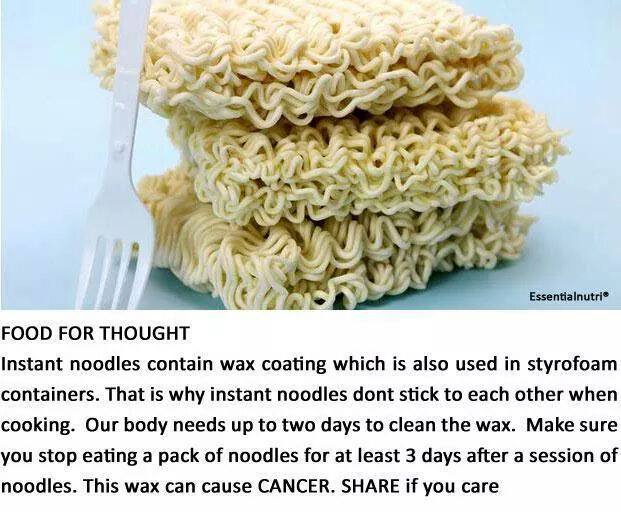
If you’re on Facebook or Twitter, it is highly probable that one of your friends has posted a story from a parody website thinking it was genuine. At they very least, you have probably seen some viral image or video purporting something that is absolutely incorrect. How do you sort the fact from fiction? It’s quite easy, if you’re intelligent and level-headed enough to take a few seconds before spreading nonsense. While the internet has made spreading BS very easy, it has also made researching potentially-BS items very easy. If you read something that is just too good to be true or has even the slightest hint of conspiracy to it, just google the keywords to see what comes up. If you’re fairly certain something is false, just google the keywords with the word “hoax” to find discussions of its inaccuracy. For example, I came across this gem on Facebook: Ramen noodles are coated with cancer-causing wax? It would take a very stupid person to believe that something like that would go unnoticed by the FDA or unreported through any of the many reputable worldwide media outlets. Someone who shares this is so dumb that they think the governments of the world, the media, and the manufacturers of the aforementioned death noodles are involved in some massive conspiracy. That’s the only thing I can come up with, because if you take two seconds to google “ramen noodles cancer,” you’ll see that some of the top results are sites devoted to calling out nonsense. Snopes.com is usually on top of things. New potential hoax items are researched and discussed on the site’s forums until enough information is available to determine if something is true, false, a mix, or simply falsely attributed. Visit this site before you share anything questionable, because it just might save you the embarrassment of being called out by one of your smarter friends who consumes their media a tad more critically. If a politician said something that seems too good to be true, a cure for something has existed all along, or something seems just a bit too ironic, check it out first. It also helps to know the websites that do nothing but post fake news stories. Most people are familiar with The Onion, but I still see someone taking a headline seriously once in a while. Below are some more parody websites that get shared waaaay too much:
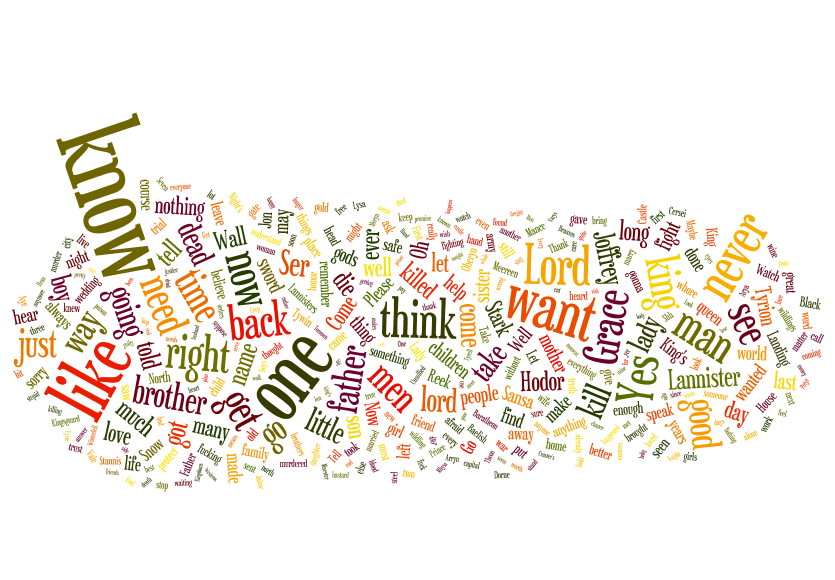
I love Wordles. If you’re not familiar with a Wordle, it is a composite image of words of varying size based on the frequency of their use. The user (that’s you) pastes a block of text or provides the URL to a webpage. Wordle then generates an image for you which you may customize with various fonts, layouts, and color schemes.
So? Why would I need a jumbled collage of words? I’ve found several great uses for them. In several of my graduate classes, I have used them as visual aids to accompany a presentation on journal articles or policy statements. It can also be a unique way of previewing a scholarly journal article (especially if it is lengthy) by glancing over the keywords that will pop up throughout. This can also give you a chance to look up any words you may be unfamiliar with beforehand. When you encounter these words in context, you will already have prior knowledge to aid in comprehension.
I used the text from the subtitle files from season 4 of Game of Thrones to generate a Wordle. I didn’t really have a motive when I set out, but I was curious to see what words and names came up the most often. This can be hard to assess qualitatively as the show bounces between several point of view characters spread across a large fictional world. I did not edit the text in anyway, so you will likely find a few words deemed naughty by the highborn.
Click to view the full image size that still isn’t terribly large.
It’s so easy for people to “research” a new health technique or practice or dietary approach and find plenty of websites supporting it, but are these practices backed by science or do they just look and sound scientific?
Spoiler Alert: It’s almost always the latter.
A few symptoms of pseudoscientific hype from RationalWiki:
A simple idea that purports to be the one answer to many problems (often including diseases)
A “scientific-sounding” reason for how it works, but little to no actual science behind it; for example, quote mines of studies that if bent enough could be described in such a way to support it, outright misapplication of studies, or words that sound scientific but make no sense in the context they are used in
Prefers to use abundant testimonials over actual scientific research [emphasis added]
I’m not trying to imply that there are zero positive benefits to some of these practices. I just want to reinforce that many of these perceived benefits may very well be the result of the Placebo Effect, a real phenomenon in which people who are given a dud treatment experience measurable results. Medical studies and pharmaceutical trials administer placebo treatments to measure the difference between what the medicine can do and what the mind and body may do if they think they are receiving a legitimate treatment.
Not every health technique, treatment, or method undergoes the strict scrutiny of a regulatory body. For some things, it simply isn’t commercially viable; for others, there exists enough empirical data to preclude testing entirely. This process exists for a reason though: anecdotes don’t cut it. One thing many articles on pseudoscientific processes share is a reliance on and overabundance of anecdotal evidence.
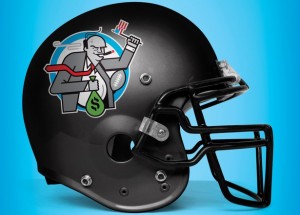
I really enjoyed this scathing review of the public finances supporting professional athletics in this country, particularly the NFL. It is available to read for free at The Atlantic.
Not being a fan of pro-athletics, many of these facts were news to me. I knew public subsidies were often used to build stadiums, but I did not know that the State of Louisiana outright bribes the Saints to stay in town. I knew many leagues were privately owned, but I did not know that the league itself was a non-profit entity. How was that ever allowed to happen?
Pro-football coaches talk about accountability and self-reliance, yet pro-football owners routinely binge on giveaways and handouts. A year after Hurricane Katrina hit New Orleans, the Saints resumed hosting NFL games: justifiably, a national feel-good story. The finances were another matter. Taxpayers have, in stages, provided about $1 billion to build and later renovate what is now known as the Mercedes-Benz Superdome. (All monetary figures in this article have been converted to 2013 dollars.) The Saints’ owner, Tom Benson, whose net worth Forbes estimates at $1.2 billion, keeps nearly all revenue from ticket sales, concessions, parking, and broadcast rights. Taxpayers even footed the bill for the addition of leather stadium seats with cup holders to cradle the drinks they are charged for at concession stands. And corporate welfare for the Saints doesn’t stop at stadium construction and renovation costs. Though Louisiana Governor Bobby Jindal claims to be an anti-spending conservative, each year the state of Louisiana forcibly extracts up to $6 million from its residents’ pockets and gives the cash to Benson as an “inducement payment”—the actual term used—to keep Benson from developing a wandering eye.